OCTOBER-2013
LATEST FROM THE ADVERTISER IN ADELAIDE

So London Here We Come!
Save Our Ship
A vigorous campaign to bring ‘Our Ship’ back to Sunderland which has lasted more than 6 years for SCARF (14 years in total) has led us to enter a final phase which includes legal and political challenges to her export from the UK.
Currently however it would not make sense to reveal the detail and extent of our work to bring her home, but you can be sure that SCARF’s legal team is burning the midnight oil to ensure we get her back on our river.
As we speak, City of Adelaide is being prepared to leave Irvine in Scotland and delivered by barge to Greenwich on the River Thames. Their plan is that before leaving for Oz she will be moored next to Cutty Sark, built 5 years later and definitely not as important.
This is Sunderland’s ship; she was built here with a revolutionary design which was copied later to build Cutty Sark.
UK taxpayers’ money to enable all this to happen (approx £1,000,000) has been ‘donated’ by the Scottish Government to send her away to Australia, forever. Money which was never offered to SCARF in Sunderland, a real kick in the teeth!
Latest News: September 2013

Marching for Our Sunderland Ship
Marching for employment and apprenticeships’
When we get City of Adelaide back home she will offer hundreds of long term jobs and apprenticeships to our people, young and old.
SCARF a Community Interest Company (SD-SCARF CIC) was set up in 2005 to raise funds for the return ‘Our Ship’ to Sunderland.
In an attempt to secure the vessel for Sunderland, SCARF has met many times with relevant individuals from Scotland, England and Australia. This has included the Chairman and senior members of the UK National Historic Ships Committee.
In our view the decision to give CSCoAL in Australia preferred bidder status in 2010 was flawed and based on incorrect data.
We need you to help, we have everything to fight for so please use the Facebook or Twitter links to get in touch.
-------------------------------------------------
Read about "The City of Adelaide"
The City of Adelaide at age 149 is the oldest of only three composite constructed (iron and teak) clipper ships to survive anywhere in the world. Experts say she is in fact more important to our maritime history than the Cutty Sark- and five years older. The National Historic Ships committee (NHSc) included the City of Adelaide in the core collection list of nationally significant vessels in the UK. In fact the NHSc have placed her in the top ten alongside other vessels such as HMS Victory, SS Great Britain and Cutty Sark.
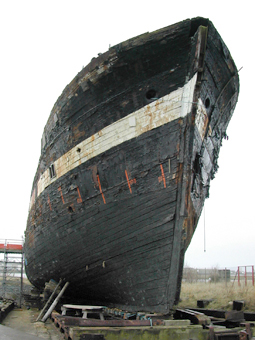
She was built on the river Wear in Sunderland, England, at the William Pile and Hay shipyard in 1864 to an order from merchants Devitt and Moore of London and was designed particularly to carry immigrant passengers and cargo mainly to and from Adelaide, South Australia. She is 54 metres long, 10 metres wide with a draft of 5.64 metres and weighing 860 tons. After her first four voyages, she was profitable enough for her owners to order a larger composite sailing ship from the same yard - her sister ship "The South Australian"
The 'City of Adelaide' over 23 years, completed some 23 trips to Adelaide South Australia and was fundamental in the development of the colony, carrying British and German immigrants and returning with cargoes of wool, wheat,and copper to the London markets. At the time she was noted and claimed to be the fastest passenger clipper, making the trip to Australia in only 64 days. Her passage took her out via South Africa and often returning around the Cape Horn, which saved time but was much more hazardous.
Her poop deck accommodated 14 first class cabin passengers, with every comfort including bathrooms, saloon/dining area with grand piano. She also offered facilities for a few second class passengers and some basic facilities for steerage passengers. She also carried a qualified surgeon.
In 1887 she was sold for the trade in bulk cargo, carrying firstly coal from Newcastle upon Tyne to Dover and then sailing on the North Atlantic timber runs. 1893 saw the end of her days under sail having been bought by Southampton Corporation and used as an isolation hospital during the outbreak of cholera.
In 1923 she was bought by the Admiralty and served as a drill training ship in Greenock with the Royal Naval Volunteer Reserve and renamed HMS Carrick. Later she went on to serve as merchant ship gunner training during World War 2 and a detention centre for deserters.
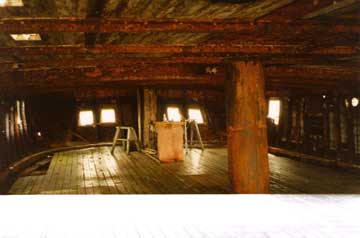
The vessel in 1947 was presented by the Admiralty to the Royal Navy Volunteer Reserve Club (Scotland) and berthed on the Clyde in central Glasgow, where it served as a gentleman's club for a further 44 years. She was refurbished in 1978 after being partially flooded and renamed with the club until she accidentally sank again in 1989 after which event the RNVR could no longer afford to maintain her. After a short time under the care of the Clyde Ships Trust in the Prince's Dock, Govan, she sank again in 1991. She was eventually handed over to the Scottish Maritime Museum and moved to her present berth on a slipway in Irvine,where it was planned to preserve and eventually restore her.
The initial funding eventually ran out and SMM struggled to make any progress with the preservation and eventually applied in 2000 to have the ship dismantled. This was rejected by North Ayshire Council, considering her importance to the maritime heritage and following world wide objections. Further applications were made in 2007 to have the ship deconstructed and this time North Ayshire council agreed.